

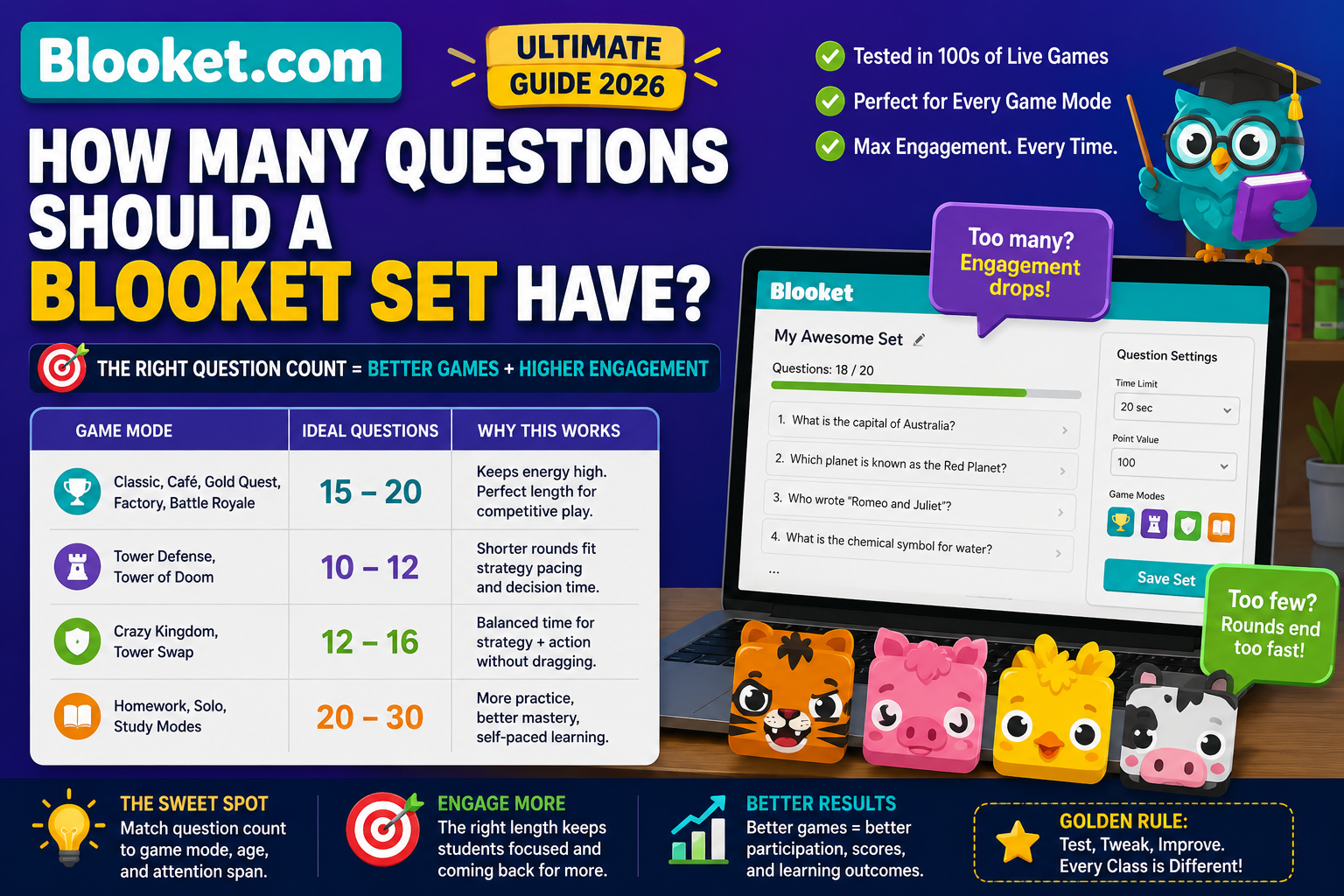
You’ve built a great question set, but the round either drags into a slog or ends before students even settle in. The fix usually isn’t the questions themselves — it’s the count. How many questions should a Blooket set have? As a starting baseline: 15 to 20 for competitive live modes, 10 to 12 for strategy-heavy modes like Tower Defense, and 20 to 30 for solo homework assignments. Push past 25 in a live game and engagement noticeably drops in the final stretch. Go below 8 and the round ends before students find any rhythm. Here’s the breakdown for every major mode, and why the number shifts the way it does.
Why Question Count Matters More Than It Seems
It’s tempting to treat question count as an afterthought — just add enough to “cover the material.” But in a live, timed, competitive format, count directly shapes pacing, and pacing is what keeps a room engaged or loses it. Too few questions and the game ends just as momentum builds. Too many and even strong players start coasting through the back half, since there’s no urgency left in a game that’s already been decided.
Question Count by Game Mode
Competitive Live Modes: 15–20 Questions
For fast, competitive modes where players are racing against each other in real time, 15 to 20 questions hits the sweet spot. This range is long enough to let genuine skill and effort separate the leaderboard, but short enough that the energy stays high from the first question to the last. Games with fewer than 15 questions in this category can feel like they end just as players are getting into a groove, while pushing past 20 starts to stretch attention spans, especially with younger students.
Strategy Modes (Tower Defense and similar): 10–12 Questions
Modes built around strategy — think Tower Defense-style formats where players are managing resources, upgrades, or defenses between questions — need a shorter question count than pure trivia races. That’s because a meaningful chunk of the round’s time is spent on strategic decisions rather than answering, so the same 20-question set that works fine in a straight quiz mode will run noticeably longer and drag in a strategy format. Sticking to 10 to 12 questions keeps the strategic layer front and center without turning the session into a marathon.
Solo or Homework Assignments: 20–30 Questions
When students are working through a set independently, rather than racing live against classmates, the pacing pressure disappears. There’s no lobby waiting, no leaderboard urgency — just a student working through material at their own speed. This makes homework-style assignments the right place to stretch the question count to 20–30, giving more complete topic coverage without the engagement risk that comes with a long live round.
What Happens When You Go Too High or Too Low
Above 25 questions in a live game: Engagement predictably collapses in the final third. Once the outcome starts to feel decided, remaining players either disengage or start rushing through answers just to finish, which undermines the actual review value of the later questions.
Below 8 questions: The round ends before most students have settled into a rhythm. This is especially noticeable with younger students or with new question sets they haven’t seen before, where the first few questions often go toward simply understanding the format rather than genuinely engaging with the content.
The sweet spot exists because attention is a resource. Every game mode has a natural window where focus, competitiveness, and pacing all line up. Overshooting or undershooting that window doesn’t just make the game longer or shorter — it actively changes how engaged players are throughout.
How Difficulty Shifts the Ideal Count
Question difficulty and count are connected. Harder questions take longer to read, process, and answer, which effectively “uses up” more of the round’s energy per question. If your set leans toward complex, multi-step, or longer-text questions:
- Trim toward the lower end of the mode’s range. A live competitive mode with genuinely difficult questions might land better at 15 rather than 20.
- Watch first-time completion rates. If a set consistently runs long or leaves several questions unanswered when time runs out, that’s a signal to shorten it rather than assume students need more practice with the format.
Conversely, simpler recall-based questions can comfortably sit toward the higher end of a mode’s range, since each individual question consumes less time and mental effort.
How Student Age Shifts the Ideal Count
Younger students generally have shorter sustained attention spans in a competitive, high-stimulation format like a live Blooket game. For younger grade levels:
- Lean toward the lower end of the recommended range for whichever mode you’re using.
- Prioritize question clarity over quantity. A shorter set of clearly-written questions consistently outperforms a longer set with any ambiguity, since younger students are more likely to get stuck or confused rather than push through.
Older students and adult learners can typically handle the higher end of each range, and in homework-style formats specifically, can often handle sets that run toward 30 questions without a meaningful drop in completion or focus.
Common Mistakes That Turn a Solid Set Into a Slog
- Building one set size for every mode. A 25-question set built for homework doesn’t automatically translate well to a live competitive round — the format changes what “too long” actually means.
- Ignoring how difficulty compounds with length. A 20-question set of easy questions and a 20-question set of dense, difficult questions are not the same time investment, even though the count matches.
- Not testing with the actual audience. A set that feels appropriately paced when you review it solo can play very differently with a full, competitive lobby of students racing the clock.
- Padding a set to “feel complete.” Adding extra questions purely to reach a round number, rather than because the content needs them, is one of the most common ways a well-paced set turns into one that drags.
Frequently Asked Questions
Is there one universal ideal number for all Blooket sets? No. The ideal count depends heavily on the game mode, since strategy-based modes need fewer questions than straight competitive quiz formats, and homework sets can run longer than either.
Should I shorten a set if students aren’t finishing it in time? Generally yes, especially in live competitive modes. A set that consistently runs out of time is a stronger signal to trim length or difficulty than to assume the pacing will improve with familiarity.
Does class size affect the ideal question count? Class size affects overall game pacing less directly than question count and mode, but larger groups can mean a slightly longer natural game length regardless of question count, since more players are answering simultaneously.
Can I reuse the same set across different game modes? You can, but be aware that a set built for one mode’s ideal length may feel too short or too long in a different mode, so it’s worth adjusting expectations (or trimming/expanding) rather than assuming a fixed set works equally well everywhere.
Final Thoughts
Getting question count right is one of the simplest, highest-impact changes you can make to how a Blooket session actually feels. Stick to 15–20 for competitive live modes, 10–12 for strategy formats like Tower Defense, and 20–30 for homework assignments — then adjust down for harder questions or younger students, and up for easier content or independent work. Get the count right, and the same set of questions plays completely differently.
