

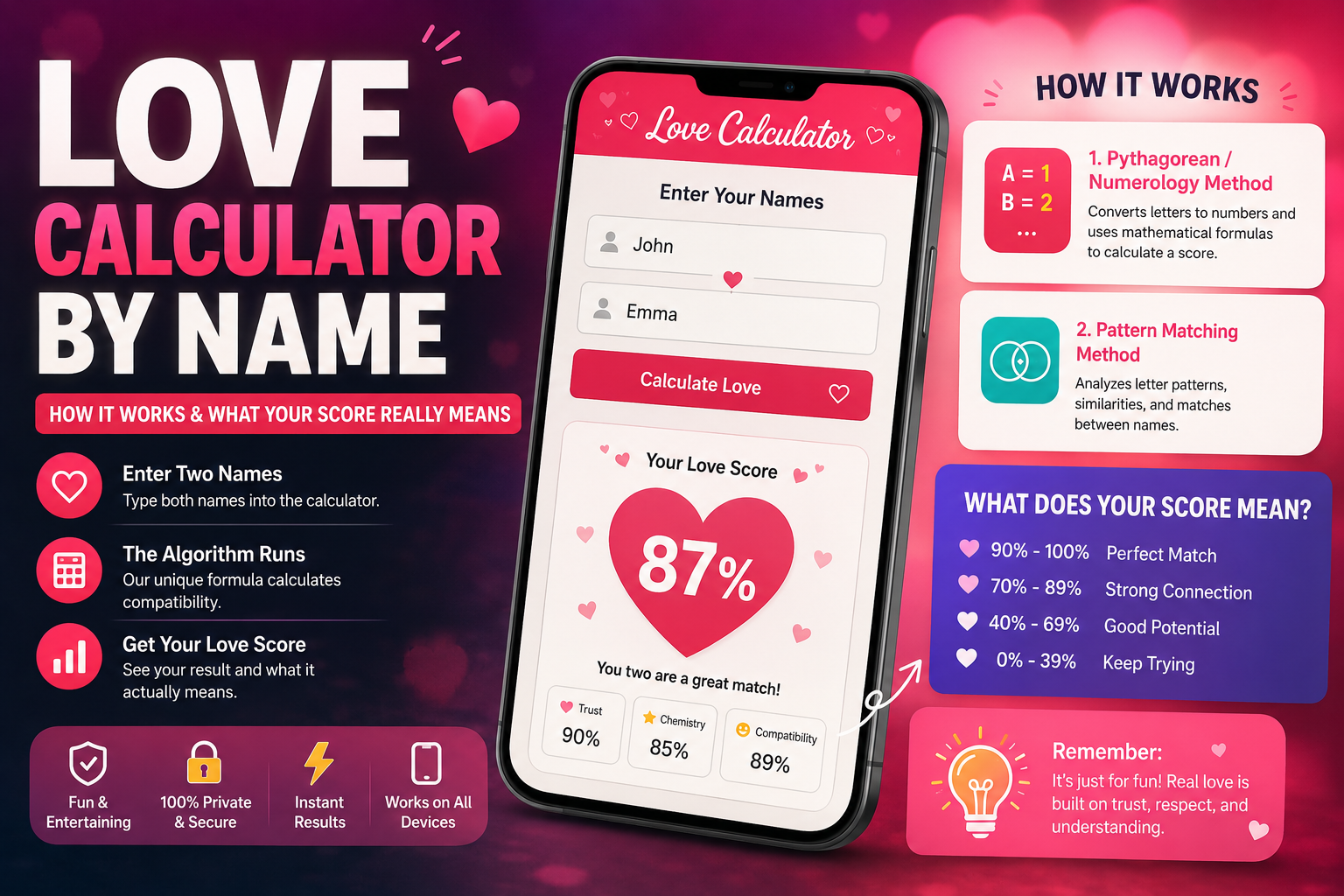
You type two names into a box, hit a button, and a number pops up telling you you’re 87% in love. Fun? No question. But what’s actually happening behind that score? Most people use a love calculator by name without ever knowing how do Love calculator Name work, what the result actually means, or why two different sites hand you two completely different numbers for the exact same couple. After tracing the logic back to the actual methods behind these tools, here’s what’s really going on — and how to read your percentage without losing sleep over it.
The Short Answer: It’s Not Measuring Love
Before anything else, the most important thing to understand is that a name-based love calculator isn’t analyzing compatibility, personality, or any real relationship data. It has no information about you or the other person beyond the letters you typed. Every calculation is a deterministic formula applied to text — meaning the same two names will always produce the same result on the same tool, every single time, because it’s math, not magic.
That said, understanding the math is genuinely interesting, and it explains a lot about why results vary so wildly between sites.
Method One: The FLAMES-Style Letter Elimination Game
The most common method traces back to an old paper-and-pencil game (sometimes called FLAMES) that got digitized into countless online calculators. Here’s roughly how it works:
- Repeated letters between the two names are cancelled out. If both names share a letter, one instance of it gets removed from each name (or in some versions, from a combined count).
- The remaining letters are counted up into a single number.
- That number is used to “count off” through a set of category words — traditionally F-L-A-M-E-S, standing for Friends, Lovers, Affection, Marriage, Enemies, Siblings — eliminating letters one at a time in a loop until only one category remains.
- The final surviving category becomes your “result,” sometimes converted into a percentage-style score depending on the specific tool.
This method is entirely dependent on letter overlap and total letter count — which is exactly why swapping a nickname for a full name, or adding a middle name, can completely change the outcome. It’s not measuring anything deeper than character counting.
Method Two: Numeric Hashing and Percentage Generators
The other common approach — especially for tools that spit out a clean percentage like “87%” — works differently:
- Each letter is converted into a number, often based on its position in the alphabet or a custom lookup table the site defines internally.
- Those numbers are combined through addition, multiplication, or some other simple arithmetic across both names.
- The result is compressed into a range, typically 0–100, through a modulo operation or similar math trick, to produce a “percentage.”
Because different sites define this lookup table and formula differently, the same two names can produce wildly different percentages depending on which calculator you use. There’s no shared standard, so a 92% on one site and a 41% on another for the same couple isn’t a contradiction — they’re simply running different arithmetic on the same input.
Why Two Sites Give You Two Different Numbers
This is the question almost everyone eventually asks, and the answer is straightforward once you understand the math: there is no universal formula. Every calculator’s creator chose their own letter-to-number mapping, their own arithmetic, and their own way of compressing the result into a percentage or category. Two calculators using the same names as input are, mathematically, running two entirely different (and entirely arbitrary) programs. Neither is more “correct” than the other, because neither is actually measuring anything real to begin with.
Does Anything About the Result Mean Something?
Not in the sense most people hope. A few things worth understanding:
- The result doesn’t reflect personality, compatibility, or relationship health. It reflects text characters run through a formula.
- Small input changes producing big output changes is expected, not a sign that something “shifted” about the relationship. Adding a middle name or changing capitalization can swing a letter-count-based result significantly.
- The entertainment value is the actual point. These tools were built as lighthearted, shareable novelty content, not predictive relationship tools, and understanding the math behind them doesn’t take away from that — if anything, it makes the “how did it get 87%” curiosity easier to satisfy.
How to Read Your Result Without Overthinking It
If you enjoy using these calculators (and there’s nothing wrong with that), a healthier way to frame the result is simply: it’s a deterministic party trick based on letters, not a verdict on your relationship. A low score doesn’t predict anything real, and a high score doesn’t confirm anything real either — it’s the same category of fun as a fortune cookie or a horoscope-style quiz, not a diagnostic tool.
If you’re specifically curious about the mechanics rather than the result itself, trying the same two names across a few different calculators is actually a great way to see the variation in action — you’ll typically get a different number from each, which reinforces just how arbitrary the underlying formulas really are.
Frequently Asked Questions
Is there a “most accurate” love calculator? No. Since none of these tools measure real compatibility data, accuracy isn’t really the right lens to evaluate them through — they’re consistent (the same input always gives the same output on a given site) but not accurate in any meaningful sense.
Why did my result change when I used a nickname instead of a full name? Because these calculators work purely off the letters typed in, changing the input text — even slightly — changes the letter count, letter overlap, or numeric mapping used in the formula, which changes the output.
Do any love calculators use real data or AI? The traditional name-based calculators described here don’t use any external data — they’re self-contained text formulas. Any tool claiming to use “AI” for this kind of calculation is still fundamentally limited by the same problem: there’s no real relationship data being analyzed, just names.
Is it worth taking the result seriously? It’s designed as lighthearted entertainment rather than a genuine assessment, so treating it as fun rather than meaningful is the healthiest way to engage with it.
Final Thoughts
Love calculator Name are simple, deterministic formulas dressed up as something mystical — either a letter-elimination game tracing back to FLAMES, or a numeric hashing trick that compresses letters into a percentage. Neither method analyzes anything about the actual people involved, which is exactly why the same couple can get wildly different scores across different sites. Once you know that, the fun doesn’t have to disappear — it just moves from “is this true?” to “how did it land on that number?”, which is a much more interesting question anyway.
READ MORE: Blooketplay
