

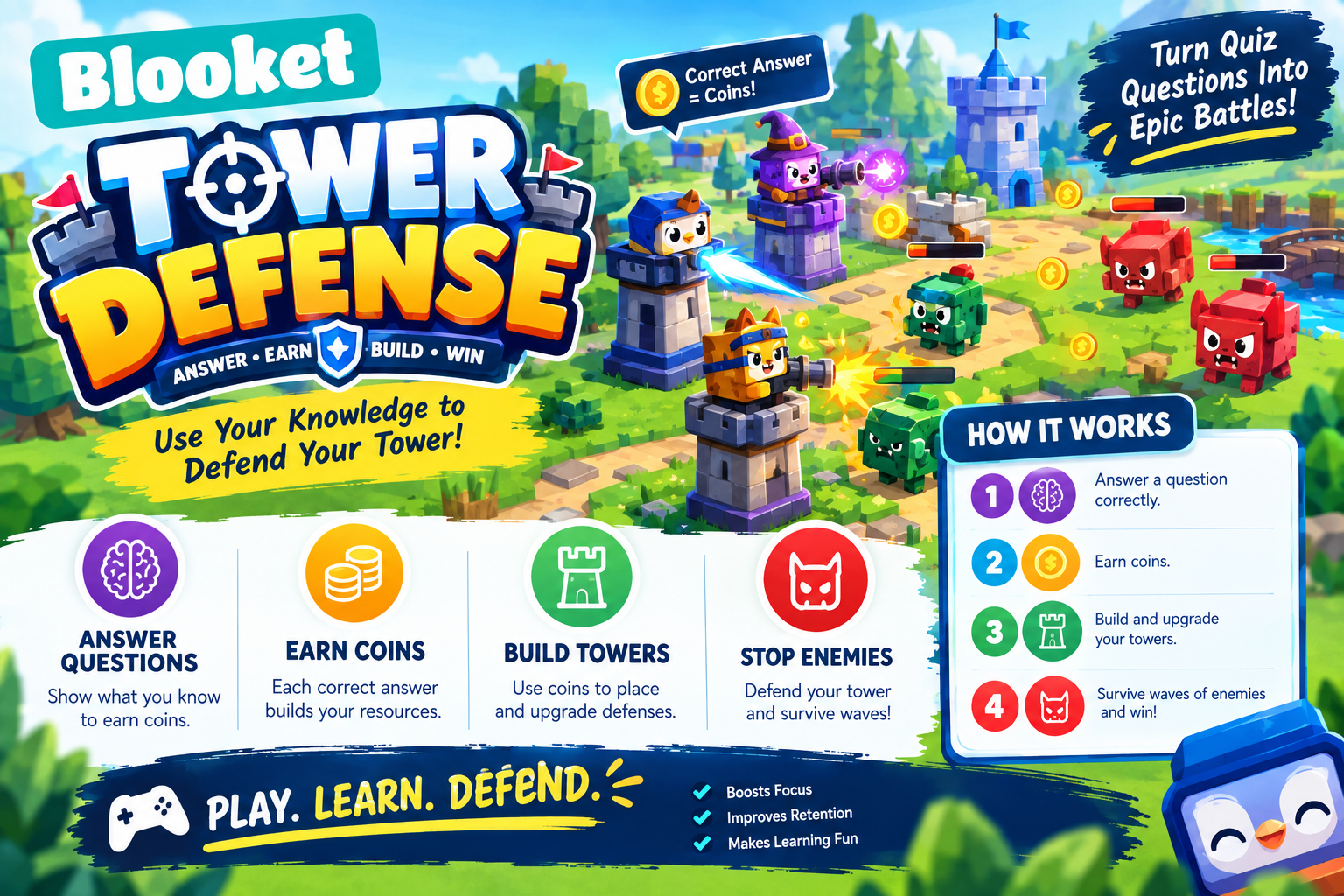
If you’ve been searching for how Blooket Tower Defense works, you’ve likely landed here after watching a class light up over a mode that turns quiz answers into an actual strategy game. Tower Defense takes the standard “answer a question, earn a point” format and rebuilds it into something closer to a real-time strategy title — correct answers fund your defenses, and how you spend that funding decides whether you survive the round.
This guide breaks down the mechanics, why the mode holds attention better than straight trivia, and how to actually get good at it.
What Tower Defense Actually Is
Tower Defense is one of Blooket’s core, currently live game modes (alongside formats like Gold Quest, Cafe, and Battle Royale). The premise: every correct answer earns in-game currency. Between question rounds, you spend that currency to place and upgrade towers that defend against incoming waves of enemy blooks. Stronger towers cost more, so you’re constantly weighing whether to save up for a bigger upgrade or spread your coins across more, cheaper defenses.
This is a meaningful departure from modes that reward speed above everything else. Tower Defense rewards consistent accuracy over time, since your entire defensive setup is funded by how well you’ve answered so far. A player who gets a few early questions wrong doesn’t just lose points — they walk into the next wave under-defended, which compounds the pressure to catch up.
Why This Format Keeps Students Focused
The reason Tower Defense performs well as a review tool comes down to the connection between content mastery and in-game consequence:
- Answers have visible stakes. In flashcard-style review, a wrong answer just moves you to the next question. In Tower Defense, a wrong answer can mean a weaker board when the next wave hits — which makes accuracy feel like it matters in the moment, not just on a scoreboard.
- It rewards sustained attention, not a hot streak. Because towers persist and upgrade over multiple rounds, a single lucky guess doesn’t carry the same weight as it might in a faster mode. Students have to stay engaged across the whole session to keep their defenses standing.
- It naturally teaches resource trade-offs. Deciding whether to upgrade one strong tower or build several weaker ones adds a layer of decision-making on top of the trivia itself, which keeps stronger students engaged even after they’ve mastered the content.
For teachers, the practical upshot is straightforward: sessions that would otherwise fade in energy around the 10-minute mark tend to hold attention through a full 20–30 minute Tower Defense round, since the “board state” gives students a reason to keep answering well.
How to Earn More Coins and Win More Rounds
If your students (or you, running a practice session) want to get better at Tower Defense specifically, a few strategies consistently help:
- Prioritize accuracy over speed early on. Since your coin total funds everything that follows, missed questions in the first few rounds have a compounding cost. Slow down and get early answers right rather than rushing.
- Don’t overspend on a single tower immediately. Early waves are usually manageable with modest defenses. Saving coins for a stronger upgrade once tougher waves start tends to outperform maxing out one tower right away.
- Watch the wave pattern, not just your coin total. Waves tend to escalate, so treat each round as a preview of what’s coming rather than reacting only after a defense fails.
- Balance breadth and depth. A few strong, upgraded towers usually outperform a wide spread of cheap ones once enemy waves get tougher — but going too narrow leaves gaps. Adjust based on how the wave difficulty is trending.
- Use it specifically for review, not first exposure. Like most Blooket modes, Tower Defense is strongest when students already have some familiarity with the material — the strategy layer works best on top of existing knowledge, not as the first introduction to it.
Making the Most of Tower Defense as a Teacher
Because Tower Defense runs longer than faster-paced modes, it’s best suited to a dedicated review block rather than a quick five-minute filler. A few practical tips:
- Pair it with a content review beforehand. Since early accuracy compounds, a quick pre-game refresher helps students hit the ground running instead of getting boxed in by early mistakes.
- Debrief afterward. Because the mode rewards strategy on top of content knowledge, a short follow-up discussion on which questions tripped students up (separate from the tower-building itself) helps you isolate genuine content gaps from in-game strategy misses.
- Use it as a mid-unit checkpoint. Its longer format and compounding accuracy mechanic make it a good fit for checking retention partway through a unit, rather than as a rapid warm-up.
Scaling Up with Blooket Plus
If you’re planning to run Tower Defense across a larger group — a full grade level or a multi-class review event — it’s worth knowing Blooket offers a paid Blooket Plus tier on top of the free version. The main relevant upgrade is a significantly higher live player cap, which matters once you’re going beyond a single classroom. Plus also tends to include earlier access to newer game modes as they roll out.
For a standard single-class session, the free tier already includes Tower Defense and most of Blooket’s core modes, so Plus is a scaling decision rather than something required to access this mode. Check Blooket’s official pricing page for current details before deciding if it’s worth it for your setup.
Frequently Asked Questions
Is Tower Defense a good mode for grading? It’s better suited to review than formal assessment, since in-game strategy (how coins are spent) affects the outcome alongside raw accuracy.
How long does a typical Tower Defense round take? It’s designed as a longer-format mode, generally holding attention for 20–30 minutes, making it a good fit for a dedicated review block.
Do I need Blooket Plus to use Tower Defense? No — it’s available on Blooket’s free tier. Plus mainly affects player capacity for larger, multi-class sessions.
Is “Booklet Tower Defense” the same thing? Yes — “Booklet” is a common misspelling of Blooket. There’s no separate product by that name.
Final Thoughts
Blooket Tower Defense earns its popularity by tying content mastery directly to visible, real-time consequences. Understanding the coin-and-upgrade loop — and coaching students to prioritize early accuracy over rushing — is the fastest way to turn a good round into a winning one, and it’s exactly why the mode keeps students focused from the first question to the last wave.
READ MORE: Blooketplay
