

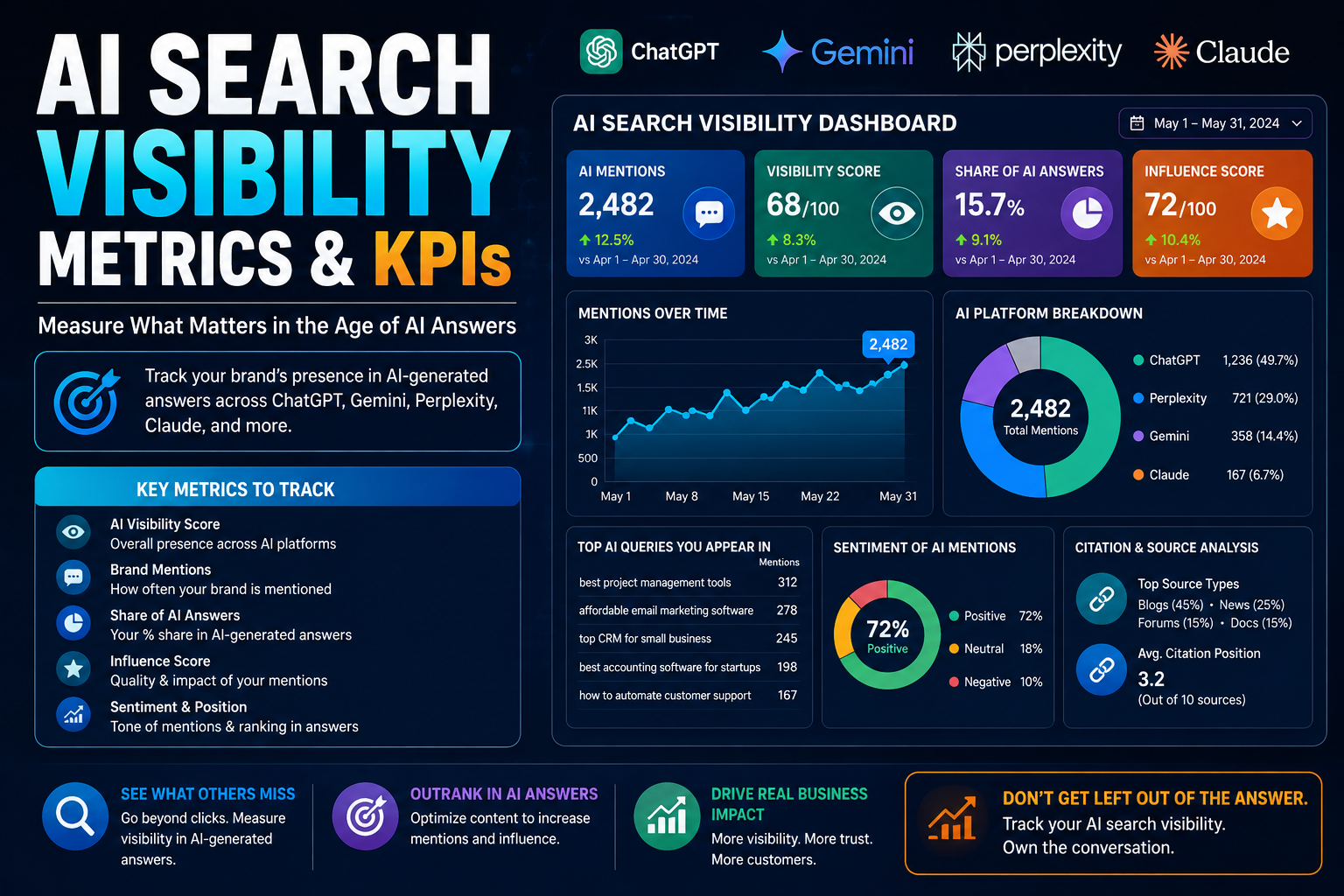
A growing share of buying decisions now start with a question typed into ChatGPT, Gemini, or Perplexity instead of a search bar. If your business isn’t showing up in those answers, you’re losing customers before they ever reach Google. The problem is that most marketing dashboards weren’t built to catch this. Google Analytics tracks clicks and sessions — it has no column for “mentioned by an AI model and never clicked.” Learning how to measure ai search visibility metrics kpis means building a new measurement layer on top of the one you already have, using metrics designed for a world where the answer often happens before the click.
Why Traditional Analytics Miss This Entirely
Search engine rankings and click-through rates were built around a simple model: a user searches, sees a list of links, and clicks one. AI-generated answers break that model. A user can get a complete, satisfying answer — including brand recommendations — without ever visiting a website. That interaction leaves no session, no pageview, and no keyword ranking to point to, even though it may have directly influenced a purchase decision. This is sometimes called the “dark traffic” problem: real influence happening completely outside what your existing analytics can see.
The Core Metrics That Actually Matter
1. Presence Rate (or Mention Rate)
The most basic and foundational metric: does your brand get named at all when a relevant question is asked? Before anything more sophisticated, this answers the simple yes/no question of baseline visibility. It’s typically measured by running a consistent set of buyer-intent prompts through major AI platforms on a recurring schedule and recording whether your brand appears.
2. Share of Voice
AI answers usually name a small handful of brands — often three to five — with no equivalent of a “page two” to fall back on. Share of voice measures how often you appear relative to your competitors across the same set of prompts, turning a simple presence check into a genuinely competitive metric.
3. Citation Rate
Separate from being mentioned by name, citation rate tracks how often your actual content or domain is cited as a source behind an AI-generated answer. Some platforms (like Perplexity) tend to cite sources with visible links fairly consistently, while others (like ChatGPT) more often mention a brand without linking to it. Tracking mention and citation as two distinct numbers gives a clearer picture than blending them into one score.
4. Answer Position
Where your brand or citation appears within an answer matters. Being named first carries more weight than being buried in a source list at the bottom of a longer response. Tracking position over time shows whether your visibility is becoming more or less prominent, not just whether it exists at all.
5. Sentiment and Framing
Being mentioned isn’t automatically a win — how you’re described matters. Tracking whether mentions are framed positively, neutrally, or negatively (and flagging any meaningful rise in negative or inaccurate framing) is an important quality layer on top of raw visibility numbers.
6. Source Mix
When an AI answer cites information about your brand, it’s worth knowing where that information is actually coming from — your own website, or third-party sites like review platforms, forums, or industry publications. If most of what’s being cited about you lives on other people’s domains, optimizing your own site alone won’t move the needle nearly as much as improving your presence on the sources actually being pulled from.
7. AI Referral Traffic
Even though many AI interactions never produce a click, some do — and that traffic is usually identifiable in your existing analytics as a distinct referral source once you know to look for it. Tracking this separately from organic search traffic helps quantify at least the visible portion of AI-driven visibility.
8. Assisted Conversions
The metric that ultimately matters most to leadership: does visibility inside AI answers correlate with actual business outcomes? This might mean tracking branded search lift after a period of strong AI visibility, or tying AI-referral sessions specifically to downstream conversions, acknowledging that some influence will always remain invisible to direct measurement.
How Often Should You Measure?
AI-generated answers are notably inconsistent — the same prompt run twice on the same platform can produce a different set of recommended brands. This means single, one-off checks are close to meaningless on their own. A more reliable approach:
- Run a fixed, repeatable list of buyer-intent prompts (commonly 20–50) across your priority platforms
- Measure on a monthly cadence rather than weekly, since short intervals mostly capture noise rather than a genuine trend
- Track relative movement over time — your own trend line and your standing against competitors — rather than chasing a single “perfect” score, since AI answer volatility makes any fixed benchmark a moving target
Which Platforms to Track
Visibility on one AI platform doesn’t reliably predict visibility on another — the underlying retrieval and citation systems differ enough between ChatGPT, Perplexity, Gemini, Claude, and Google’s AI-generated overviews that meaningful overlap between them can be surprisingly low. Practically, this means a real AI visibility strategy needs to track each major platform individually rather than treating “AI search” as a single measurement target.
Tools That Help Track These Metrics
A handful of platforms have emerged specifically to automate this kind of tracking, since manually running dozens of prompts across multiple AI tools every month doesn’t scale well by hand. Purpose-built AI visibility trackers can monitor brand citations and mentions across ChatGPT, Perplexity, and Gemini on an ongoing basis, while some established SEO platforms have added AI-visibility reporting features directly into tools teams already use for organic search tracking. Free directional tools also exist for a quick first look, though they generally don’t replace a proper ongoing tracking system. Whichever combination you use, most guidance agrees on one point: automated tools give you scale and a trend line, but periodically reading the actual AI-generated answers yourself — the specific wording, framing, and reasoning behind a recommendation — surfaces details that a dashboard number alone won’t show.
Building a Simple Reporting Structure
A practical way to organize these metrics for ongoing reporting is to separate them into layers:
- Visibility layer (checked frequently): presence rate, share of voice, citation rate
- Quality layer (checked monthly): answer position, sentiment, source mix
- Business layer (tied to outcomes): AI referral traffic, assisted conversions, branded search lift
Reserve the detailed, query-level data — individual prompt results, specific sentiment excerpts, platform-by-platform drift — for an appendix or working document, and keep the metrics reported to leadership focused on the ones that connect most directly to business outcomes rather than vanity numbers.
Common Mistakes to Avoid
- Treating a single prompt run as a definitive result, when AI answer volatility means one check reflects a moment, not a trend.
- Chasing a perfect score instead of relative competitive standing, since AI visibility should be measured against competitors, not an arbitrary fixed target.
- Only tracking one platform, when low overlap between engines means strong visibility on one doesn’t imply strong visibility elsewhere.
- Ignoring source mix, and optimizing only your own website when much of what’s being cited about you actually lives on third-party domains.
Frequently Asked Questions
Is AI search visibility the same as traditional SEO? No. Traditional SEO metrics (rankings, clicks, impressions) don’t capture whether an AI model mentioned or cited your brand in a generated answer, which is why a separate measurement layer is needed alongside existing SEO tracking.
How many prompts should I track each month? Guidance commonly suggests a fixed set in the range of 20 to 50 buyer-intent prompts run consistently, since a small, ad hoc sample won’t produce a reliable trend given how much AI answers vary between runs.
Do I need different tools for different AI platforms? Not necessarily — several tools now track multiple platforms (like ChatGPT, Perplexity, and Gemini) within a single dashboard, though supplementing automated tracking with manual review of actual answers is still recommended.
What’s the single most important metric to start with? Presence rate is the most fundamental starting point, since it answers the basic question of whether your brand shows up at all before more nuanced metrics like sentiment or source mix become meaningful.
Final Thoughts
Measuring AI search visibility means accepting that your existing analytics stack was built for a different kind of search behavior, and building a parallel measurement layer specifically for how AI platforms surface, cite, and frame your brand. Start with presence rate and share of voice to establish a baseline, layer in citation rate and source mix to understand where the underlying influence actually comes from, and connect it all back to referral traffic and conversions wherever you can. It won’t capture every bit of AI-driven influence — some of that will always stay invisible — but a consistent, multi-platform measurement cadence turns a genuine blind spot into something you can actually track and improve.
