

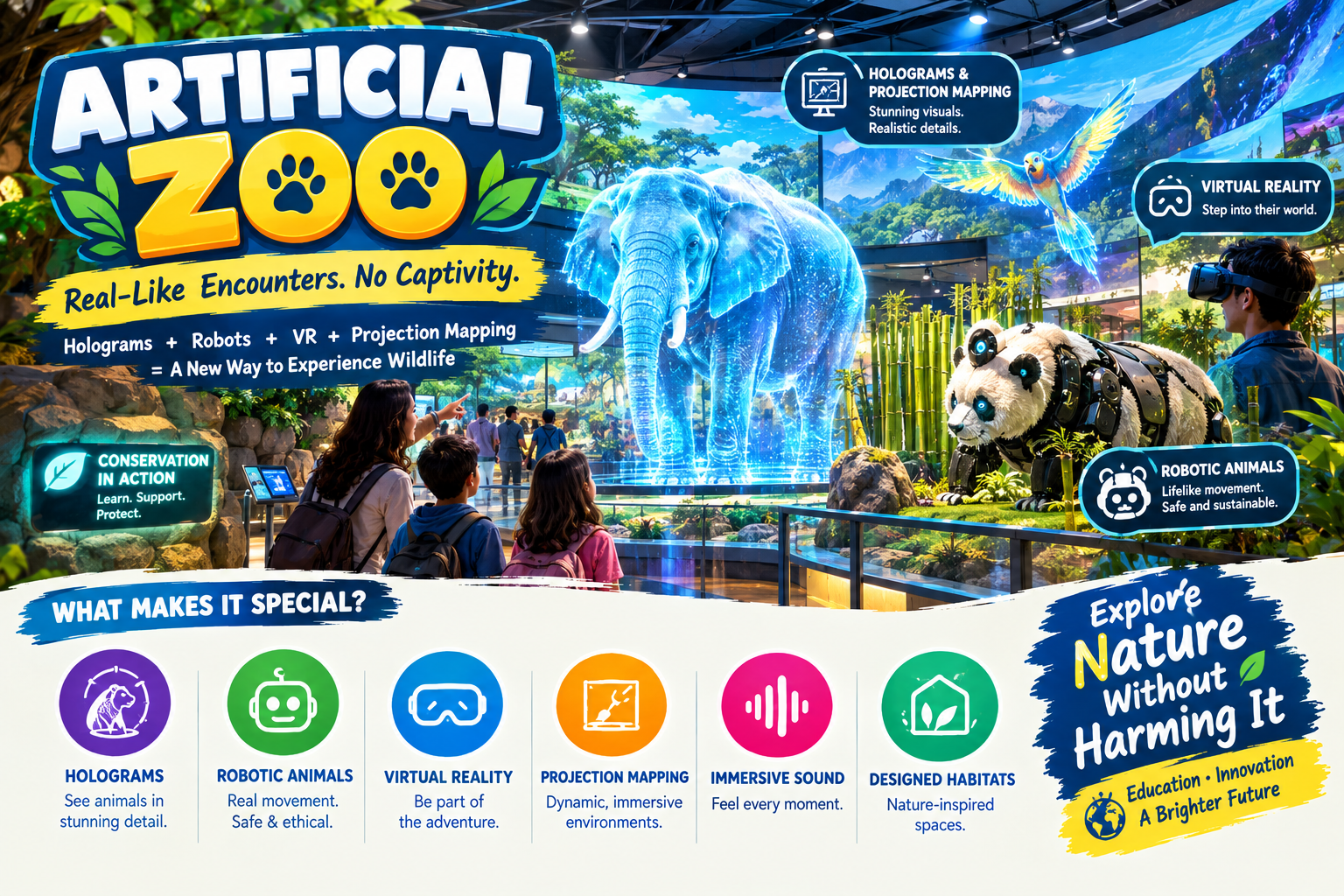
If you’ve found yourself asking what is an artificial zoo, you’re likely reacting to the same discomfort a lot of travelers quietly feel at traditional zoos: watching an animal that clearly belongs somewhere else, pacing behind glass or fencing. An artificial zoo is a direct response to that feeling. Rather than housing live animals, it recreates the experience of encountering wildlife using holograms, robotics, virtual reality, projection mapping, immersive sound, and carefully designed habitats — without a single living creature kept in an enclosure.
This guide explains how the concept actually works, what technology makes it possible, and a real attraction already using it.
The Core Idea Behind an Artificial Zoo
Traditional zoos exist because they’re one of the only ways most people will ever see a tiger, elephant, or blue whale in person. But that access comes at a cost some visitors aren’t comfortable with: permanent captivity, limited space, and animals displaying behaviors that don’t occur in the wild.
An artificial zoo tries to solve the same problem — giving people a close, memorable encounter with wildlife they’d otherwise never see — without keeping any animal confined to make it happen. Instead of a living creature behind a barrier, you get a projected or robotic recreation convincing enough to trigger the same sense of wonder, layered with the same environmental storytelling a good zoo exhibit would use.
The Technology That Makes It Work
A few different tools tend to combine inside an artificial zoo, each doing a different part of the job:
- Holograms and laser-light projection. Instead of a screen, some attractions use beams of light to create three-dimensional images that appear to hover in the air or move through a room, viewed through special glasses that separate each visitor’s individual perspective.
- Robotic animals. Animatronic creatures add a physical presence a projection can’t — something visitors can walk past, watch move on its own, or in some setups, interact with directly.
- Virtual and augmented reality. VR headsets or AR overlays place animals into an environment relative to the visitor’s own movement, letting them “walk through” a habitat rather than view it from a fixed spot.
- Projection mapping and immersive sound. Wraparound visuals and spatial audio turn a room into a convincing stand-in for a savanna, ocean floor, or arctic tundra, reinforcing the illusion well beyond what the animal alone provides.
- Designed habitats. Even without live animals, physical set design — lighting, texture, temperature, layout — keeps the space from feeling like a screen room instead of an environment.
The result sits in an unusual middle ground: part museum exhibit, part theme park attraction, part conservation-focused classroom.
A Real Example: Hologram Zoo
The clearest existing version of this concept is the Hologram Zoo, created by Australian company Axiom Holographics. It opened in Brisbane in December 2022, billed as the world’s first hologram zoo, and uses laser-light technology to project life-sized, three-dimensional animals that visitors view through special glasses — more than 50 holographic creatures in total, from elephants to dinosaurs.
Visitors move through themed sections covering an African savanna, Australian wildlife, the Arctic, an underwater environment, and a prehistoric dinosaur exhibit, all recreated through laser-based holograms projected inside large walk-through tunnels. Some installations even build in interaction, letting visitors hold out a hand toward holographic grass that an animal appears to eat.
The concept has since expanded well past its original Brisbane location. It now operates as a franchised, equipment-based business model with over 40 centres worldwide, where individual operators own and run their own installation with training and content support. A U.S. location has also opened in Easton, Pennsylvania, with the family behind it citing both an interest in technology and a preference for cruelty-free alternatives to traditional captive-animal attractions as their reasoning. The format has picked up mainstream recognition too, landing a spot on TIME Magazine’s list of top inventions in 2023 and winning an Edison Award in 2024.
Why Interest in This Model Is Growing
A few forces are pushing artificial zoos from novelty into a more serious alternative:
- Shifting visitor attitudes. A growing share of travelers, especially younger ones, are uncomfortable with captive-animal attractions, even when the animals are well cared for.
- Access to animals that can’t realistically be housed. A blue whale, an extinct species, or an animal from a remote, hard-to-replicate climate simply isn’t practical to keep in a physical enclosure — but it can be recreated convincingly with holograms or projection.
- Lower long-term overhead for operators. No live-animal care, veterinary costs, or habitat maintenance means a different, often more predictable, cost structure for the business running the attraction.
- A built-in conservation narrative. Because the format doesn’t require a living animal to justify its existence, exhibits can lean into education and storytelling about a species without the ethical tension of using that same species as the display.
Limitations Worth Knowing
An artificial zoo isn’t a perfect substitute for the real thing, and it’s worth being upfront about that. The encounter is visual and auditory, not physical — you can’t smell, feed, or make unscripted contact the way you might at a hands-on wildlife sanctuary. The experience is also built around a fixed set of pre-designed shows or environments rather than the unpredictability of a live animal’s actual behavior. For visitors specifically looking for a genuine animal encounter rather than a themed experience, this is a meaningfully different product, not a direct replacement.
Frequently Asked Questions
Is an artificial zoo the same as a virtual reality experience? Not exactly. VR is often one component, but most artificial zoos combine several technologies — holograms, robotics, and physical set design — into a walk-through, in-person attraction rather than a single headset-based experience.
Are artificial zoos meant to replace traditional zoos? Most current examples position themselves as an alternative or complement rather than a direct replacement, particularly for species that are difficult or impossible to house safely in captivity.
Where can you currently visit one? Hologram Zoo locations operate in multiple countries, including Australia, Canada, and the United States, with more installations opening under a franchise model.
Final Thoughts
An artificial zoo answers a specific, growing discomfort: wanting the wonder of seeing wildlife up close without the ethical weight of captivity. By combining holograms, robotics, projection mapping, and immersive sound inside a purpose-built space, attractions like Hologram Zoo show the concept is well past the experimental stage — it’s already a working business model with real locations, real visitors, and real industry recognition.
