

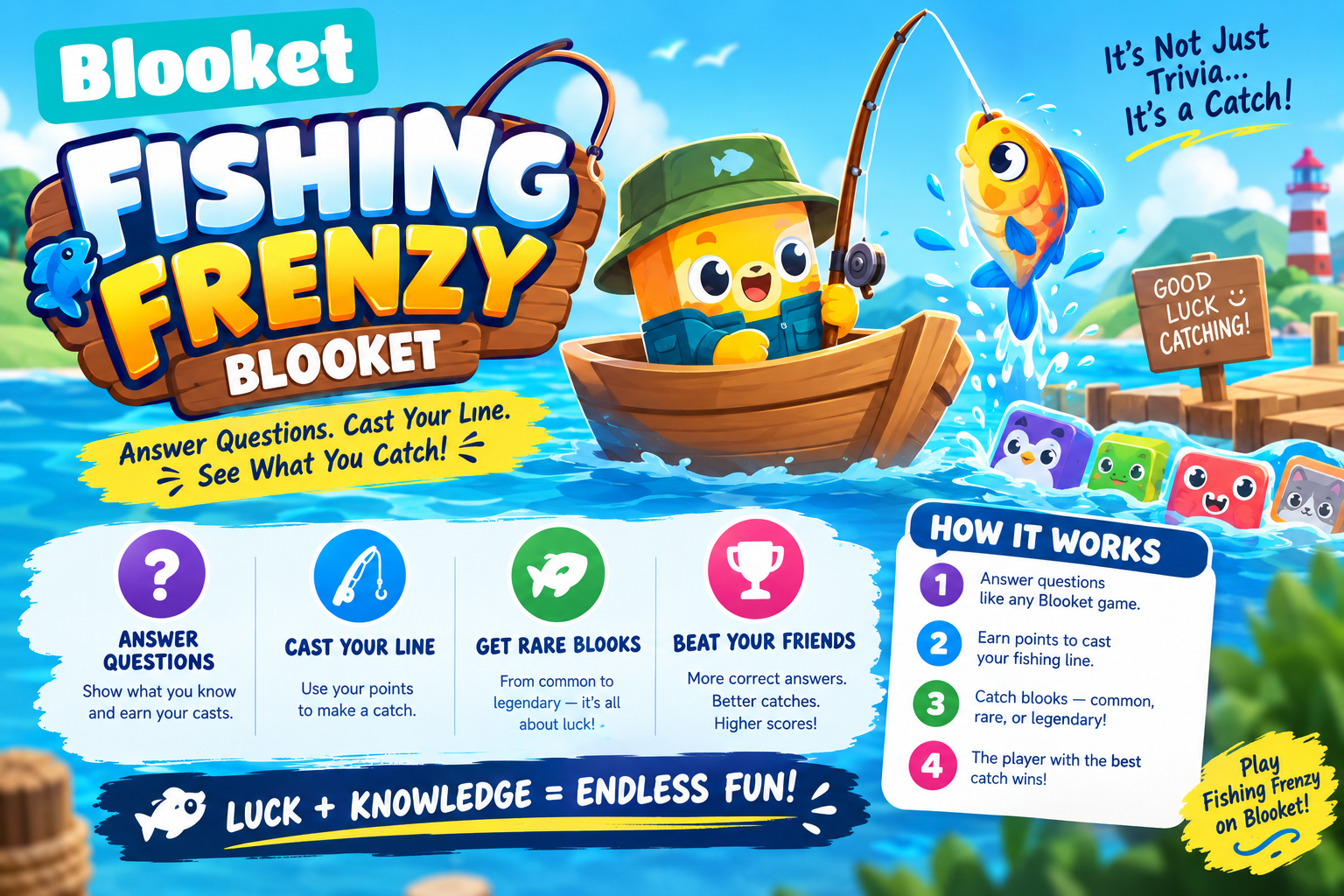
If you’re researching the Fishing Frenzy Blooket game mode, you’ve probably already noticed the pattern: it’s one of the modes students ask for by name, session after session. Unlike straightforward trivia formats where the smartest or fastest player wins every time, Fishing Frenzy folds in a genuine luck element — and that single design choice changes the entire energy of the room.
Here’s what makes this mode different, why teachers keep coming back to it, and how to get the most out of it.
What Makes Fishing Frenzy Different
Blooket’s official game mode list confirms Fishing Frenzy as one of its live, hostable formats alongside modes like Gold Quest, Battle Royale, and Tower Defense. But where those modes tend to reward pure accuracy or speed, Fishing Frenzy layers in unpredictability: your result depends not just on how many questions you get right, but on the luck of the “catch” tied to your performance.
That’s the mechanic your students will notice first. A player who has answered every single question correctly can still watch a classmate pull ahead thanks to a rare catch late in the round. It sounds like it should be frustrating — but in practice, it’s the opposite. Because outcomes aren’t fully locked in until the final question, nobody checks out early. The strongest student stays sharp because their lead isn’t guaranteed, and the student who’s behind stays hopeful because one good round can close the gap.
Why the Luck Element Actually Helps Engagement
It’s worth pausing on why this works, because it runs counter to a lot of standard classroom-gamification advice, which usually says “reward accuracy predictably.” Fishing Frenzy breaks that rule on purpose, and the payoff shows up in a few specific ways:
- Sustained attention. In a straight trivia mode, a student who falls behind early often mentally checks out, since the outcome feels decided. Fishing Frenzy’s variance keeps that door open until the last question.
- Lower stakes for struggling students. Because a lucky catch can offset a few missed questions, students who aren’t top scorers still have a real shot at winning — which keeps participation up instead of turning the game into a leaderboard only the strongest players enjoy.
- Replayability. The same question set feels different each time you run it, since the outcome isn’t purely a rerun of who answered fastest.
For teachers specifically, this matters because engagement is the actual bottleneck in most review sessions — not content difficulty. A mode that keeps the whole room invested until the final question does more for retention than a slightly harder or easier question set ever will.
How to Get the Most Out of Fishing Frenzy in Your Classroom
A few practical notes if you’re planning to run it:
- Use it for review, not first-time instruction. Like most Blooket modes, Fishing Frenzy works best once students already have some familiarity with the content — the luck element is fun on top of solid knowledge, not a substitute for it.
- Set expectations before you start. If students don’t know luck is part of the mode, a strong player losing can feel unfair. A thirty-second explanation upfront (“this one has a luck twist”) heads off confusion.
- Pair it with a no-luck mode across the week. Since Fishing Frenzy isn’t a pure measure of mastery, don’t rely on it alone for anything you’re using as an assessment. Alternate it with a mode like Classic when you need cleaner data on who knows what.
- Watch the pacing. Rounds move quickly, so it’s a strong fit for a 10–15 minute review block between lessons rather than an entire class period.
Where Blooket Plus Fits In
If your class regularly runs games like Fishing Frenzy, it’s worth knowing that Blooket offers a paid Blooket Plus tier on top of its free version. The main practical upgrade for most classrooms is a much higher live player cap, which matters if you’re running whole-grade or multi-class sessions rather than a single class of 25–30 students. Plus also tends to get early access to newer or seasonal game modes before they roll out to free accounts.
If you’re only hosting single-class sessions, the free tier already includes Fishing Frenzy and most of Blooket’s core modes, so Plus is really a scale decision rather than something you need to unlock the mode itself. Current pricing and exact feature breakdowns change periodically, so it’s worth checking Blooket’s official pricing page directly before deciding if the upgrade is worth it for your use case.
Frequently Asked Questions
Is Fishing Frenzy still available in Blooket in 2026? Yes — it’s listed among Blooket’s current live, hostable game modes.
Does Fishing Frenzy require Blooket Plus? No, it’s available on the free tier. Plus mainly affects player capacity and access to additional seasonal modes.
Is Fishing Frenzy a good mode for grading or assessment? Not on its own. Because a luck-based catch mechanic affects the outcome, it’s better suited to review and engagement than as a precise measure of individual mastery.
How long does a typical Fishing Frenzy round take? It’s designed as a shorter-format mode, making it a good fit for quick review blocks rather than a full class period.
Final Thoughts
The Fishing Frenzy Blooket game mode earns its popularity by doing something most trivia formats avoid: refusing to let the outcome feel decided early. That unpredictability is exactly what keeps a room of students locked in until the last question, regardless of how the first half of the game went. If your reviews tend to lose steam halfway through, this is one of the more reliable modes to bring the energy back.
READ MORE: Blooketplay
