

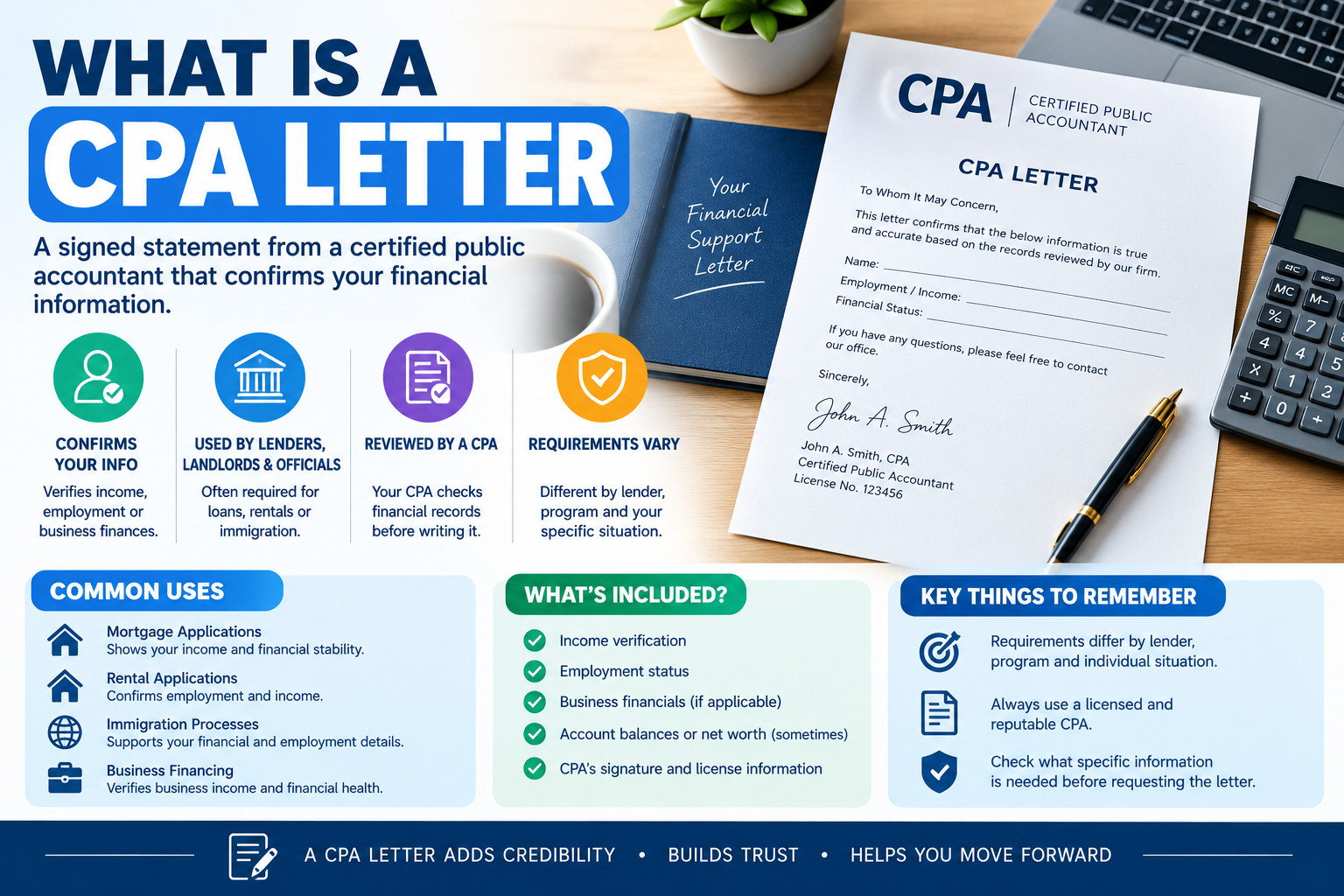
A lender, landlord, or immigration official has asked for a “CPA letter,” and now you’re trying to figure out what that actually means and how to get one. A CPA letter is a signed statement from a certified public accountant confirming specific facts about a person’s income, employment, or business finances. Because the CPA reviews financial records before writing it, the letter carries more weight than a self-reported pay stub or a personal explanation alone. Here’s exactly how to get a CPA letter for income verification, what it typically needs to include, and what to expect from the process.
What a CPA Letter Actually Does
A CPA letter exists to add third-party credibility to a specific financial claim. Rather than simply taking your word for your income or business standing, the requesting party — a mortgage lender, a landlord, a visa or immigration office — gets a signed statement from a licensed professional who has reviewed the underlying documentation and is putting their credentials behind the accuracy of what’s stated.
This matters most in situations where standard documentation (like W-2s or recent pay stubs) doesn’t tell the full story on its own — self-employed individuals, business owners, and applicants with non-traditional income are the most common groups asked to provide one.
When You’re Typically Asked for One
- Mortgage or loan applications, particularly for self-employed borrowers whose income isn’t easily verified through standard payroll documentation
- Rental applications, especially for freelancers, contractors, or business owners applying to lease a property
- Immigration or visa applications, where sponsors or applicants need to demonstrate financial stability or ability to support themselves
- Business loan or investment situations, where a lender or investor wants independent confirmation of a company’s financial standing
How to Get a CPA Letter: Step-by-Step
1. Confirm Exactly What’s Being Requested
Before contacting a CPA, get specifics from whoever is requesting the letter — a lender, landlord, or immigration office often has particular requirements about what the letter needs to state, and sometimes even specific wording or formatting expectations. Bringing this information to your CPA upfront saves time and avoids a letter that needs to be redone.
2. Find a CPA (or Use Your Existing One)
If you already work with a CPA for tax preparation or bookkeeping, they’re usually the fastest path, since they already have access to your financial history. If you don’t have one, look specifically for a CPA experienced with the type of letter you need — a CPA who regularly handles self-employment income verification, for example, will be more efficient than one unfamiliar with the format lenders expect.
3. Provide Financial Documentation
The CPA needs to review actual records before they can put their name behind any claim. Depending on the letter’s purpose, this commonly includes:
- Recent tax returns (often the last one to three years)
- Profit and loss statements, if you run a business
- Bank statements supporting income claims
- Business licenses or formation documents, for business-related letters
4. Clarify the Specific Facts the Letter Needs to Confirm
CPA letters vary significantly in scope. Some confirm a specific income figure; others confirm ongoing self-employment status, business ownership, or general financial standing. Be precise about what needs to be stated, since a vague request can result in a letter that doesn’t fully satisfy the requesting party’s requirements.
5. Review the Draft Before It’s Finalized
Once the CPA drafts the letter, review it against the original request to confirm it includes everything needed — correct names, dates, figures, and any required formatting or signature elements. It’s much easier to catch a gap at this stage than after the letter has already been submitted to a lender or agency.
6. Receive the Signed, Dated Letter
A CPA letter typically needs to be recently dated, signed, and often includes the CPA’s license number and firm information. Some requesting parties have specific requirements about how recent the letter needs to be — check this before assuming an older letter will still be accepted.
What Should Be Included in a CPA Letter
While requirements vary by lender, program, and situation, most CPA letters include:
- The CPA’s name, license number, and firm information
- A clear statement of what’s being confirmed — income amount, self-employment status, business ownership, etc.
- The time period the confirmation covers (for example, “for the tax years 2024 and 2025”)
- A statement that the CPA reviewed specific financial records in preparing the letter
- The CPA’s signature and the date the letter was issued
- Contact information, in case the requesting party needs to verify the letter’s authenticity
What Does a CPA Letter Typically Cost?
Costs vary depending on the CPA, the complexity of the review, and how established your relationship with them already is. A simple letter for an existing client with straightforward, well-documented income is generally less expensive than one requiring a deeper financial review for a new client or a more complex business situation. It’s reasonable to ask for a cost estimate upfront once you’ve explained what the letter needs to cover.
How Long Does It Take?
Turnaround time depends heavily on how complete your documentation already is. If your CPA already has your recent tax returns and financial statements on file, a straightforward letter can often be turned around within a few business days. More complex requests — particularly those requiring the CPA to review documentation they haven’t previously seen — can take longer, so it’s worth requesting the letter with some lead time before a submission deadline rather than at the last minute.
Common Mistakes to Avoid
- Not confirming exact requirements before requesting the letter. A generic CPA letter may not satisfy a lender or agency with specific formatting or content expectations.
- Waiting until the deadline is close. Reviewing financial documentation takes time, and a rushed request can lead to errors or an incomplete letter.
- Assuming any CPA letter works for any purpose. A letter written for a mortgage lender may not automatically satisfy an immigration office’s separate requirements, even if both are technically “CPA letters.”
- Not reviewing the draft carefully. Since the letter is meant to be relied upon by a third party, even small factual errors can cause delays or rejection.
Frequently Asked Questions
Does the CPA need to be licensed in my state? Requirements can vary by the requesting party, so it’s worth confirming, but generally a CPA’s license is recognized across state lines for the purpose of financial verification, particularly for federal processes like immigration applications.
Can any accountant write a CPA letter, or does it need to be a licensed CPA specifically? It needs to be a licensed CPA specifically. The letter’s credibility comes directly from the CPA designation and license, so a bookkeeper or non-licensed accountant generally can’t fulfill this requirement.
How recent does a CPA letter need to be? This depends entirely on the requesting party’s requirements. Some accept letters issued within the last few months; others require something issued much more recently. Always confirm this before submitting.
Can I use the same CPA letter for multiple purposes? Not typically. Since different lenders, landlords, or agencies often require specific wording or confirmations, a letter written for one purpose may not satisfy a different one, even if the underlying financial facts are the same.
Final Thoughts
Getting a CPA letter for income verification comes down to a few clear steps: confirm exactly what’s being requested, provide your CPA with complete financial documentation, and review the draft carefully before it’s finalized. Because requirements vary so much by lender, program, and situation, the most important thing you can do upfront is get precise about what needs to be confirmed — that single step prevents most of the delays and rejected submissions that come with CPA letters otherwise.
