

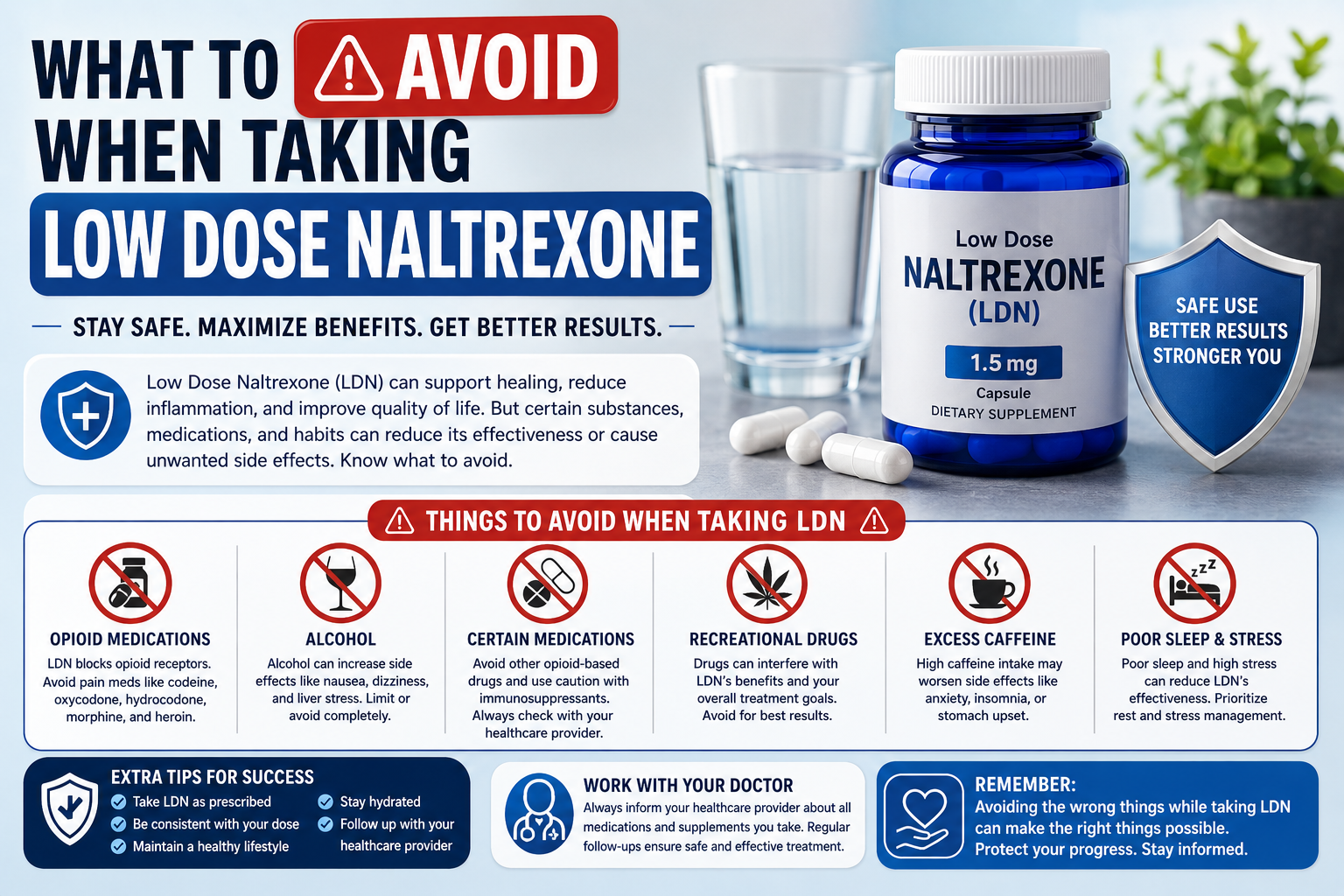
Low Dose Naltrexone (LDN) has drawn growing interest for its potential role in managing chronic pain, autoimmune conditions, and addiction recovery. But getting the most out of it — and avoiding serious complications — depends heavily on understanding what to avoid when taking Low Dose Naltrexone. Because LDN works by blocking opioid receptors, even at low doses, certain medications, substances, and habits can interfere with its effectiveness or trigger genuinely dangerous reactions. This guide walks through the key things to avoid, based on how LDN actually works in the body. It’s educational information, not a substitute for guidance from your prescribing provider.
Why This Matters: How LDN Works
Naltrexone is an opioid receptor antagonist — at standard doses, it’s FDA-approved for treating opioid and alcohol use disorders by blocking opioid effects outright. At low doses (typically in the 1–5 mg range), it’s used off-label for its proposed effects on inflammation and immune modulation, which is why it’s explored for conditions like fibromyalgia, Crohn’s disease, and chronic pain syndromes. Because the underlying mechanism — opioid receptor blockade — is the same regardless of dose, several of the same precautions that apply to standard-dose naltrexone still apply at the “low dose” level, just with different risk magnitudes.
The Most Important Thing to Avoid: Opioids
This is, by a wide margin, the most critical interaction to understand. Combining LDN with opioids — whether prescription pain medication or illicit opioids — can trigger precipitated opioid withdrawal, a sudden and intense withdrawal reaction caused by naltrexone abruptly blocking opioid receptors that opioids are actively occupying.
This includes:
- Prescription opioid pain medications (oxycodone, morphine, hydrocodone, fentanyl, and similar)
- Illicit opioids, including heroin
- Opioid-containing cough medications, some of which contain codeine or hydrocodone and are easy to overlook
- Certain anti-diarrheal medications, like loperamide (Imodium), which technically acts on opioid receptors
Because opioids can show up in places people don’t expect — cough syrups and antidiarrheals being common examples — it’s worth checking the active ingredients of any over-the-counter medication before combining it with LDN. Most guidance recommends avoiding opioid use entirely for a period (commonly cited as roughly 7–10 days) before starting naltrexone therapy, and your prescribing provider should confirm the appropriate window for your specific situation.
Use Caution With Benzodiazepines
Benzodiazepines (“benzos”), commonly prescribed for anxiety or panic disorders, are another category worth discussing carefully with your provider. Some clinical guidance suggests benzodiazepines may interfere with LDN’s effectiveness and can carry an increased risk of adverse effects when combined. This isn’t necessarily an absolute contraindication — some providers do prescribe both together with monitoring — but it’s a combination that should be actively managed by a healthcare professional rather than something to combine without discussion.
Be Cautious With Alcohol
Alcohol’s interaction with LDN is generally described as reducing LDN’s effectiveness rather than causing a dangerous acute reaction the way opioid combination can. Still, since standard-dose naltrexone is itself an approved treatment for alcohol dependence, the relationship between naltrexone and alcohol is well studied, and moderating alcohol intake is a reasonable precaution while on LDN therapy, particularly if you’re using it for an inflammatory or autoimmune condition where consistent effectiveness matters.
Don’t Adjust Your Dose Without Guidance
LDN is typically compounded at low doses specifically because standard commercial naltrexone tablets are formulated for much higher doses used in addiction treatment. This means:
- Don’t assume a higher dose works better. LDN’s proposed mechanism relies on the specific low-dose range; higher doses can shift the drug’s effects toward standard-dose naltrexone’s opioid-blocking profile rather than the low-dose mechanism it’s being used for.
- Don’t split or adjust compounded doses on your own without your prescriber’s or compounding pharmacy’s guidance, since compounded formulations can vary in concentration and consistency between pharmacies.
- Report side effects rather than self-adjusting. Reported side effects with LDN are generally described as mild — things like vivid dreams, sleep disruption, or headache — but any adjustment to dosing should go through your provider rather than trial and error at home.
Tell Every Provider You’re Taking LDN
Because LDN can interact with pain management plans (particularly around opioid-based treatment) and certain other medications, it’s important that every provider involved in your care — not just the one who prescribed LDN — knows you’re taking it. This matters especially for:
- Planned surgeries, where opioid-based pain management is standard and precipitated withdrawal risk needs to be planned around in advance
- Emergency care, where a provider unaware of LDN use might otherwise administer opioids without accounting for the interaction
- Any new prescription, since the full list of potential interactions with LDN isn’t exhaustively documented and providers need complete medication information to assess risk
What’s Generally Considered Safe Alongside LDN
To be clear, LDN isn’t a medication that requires avoiding most other treatments. Commonly cited as generally compatible (though individual cases can vary) are:
- Non-opioid pain relievers, such as acetaminophen and NSAIDs like ibuprofen
- Common medications for chronic conditions like hypertension, diabetes, or heart disease, which typically don’t show significant interaction concerns with LDN
Even so, “generally compatible” isn’t the same as “confirmed safe for your specific situation” — a full medication review with your provider remains the right step before starting LDN, not an optional formality.
If You’re Currently on Opioid Therapy
If you’re currently being treated with opioids for pain management and are considering LDN, this transition needs to be medically supervised. A safe switch typically involves a structured opioid taper or washout period under a healthcare provider’s guidance, rather than stopping opioids abruptly on your own and starting LDN shortly after. This is a situation where self-managing the transition carries real risk, and working directly with your prescriber is essential.
Frequently Asked Questions
Can I take LDN if I’m currently on pain medication? This requires direct medical supervision. Combining opioids with naltrexone, even at low doses, risks precipitated withdrawal, so any transition needs to be planned and managed by your provider.
Is it dangerous to accidentally take an opioid-containing medication while on LDN? It can cause an uncomfortable and potentially severe withdrawal-like reaction. If this happens, contact your prescribing provider or seek medical guidance promptly rather than waiting to see if symptoms resolve on their own.
Does LDN interact with all common medications? No — many common medications for chronic conditions like blood pressure or diabetes are generally considered compatible. The main categories of concern are opioids, and to a lesser extent, benzodiazepines and alcohol.
Can I just increase my LDN dose if I’m not seeing results? No — dose adjustments should always go through your prescriber, since LDN’s proposed mechanism is specific to its low-dose range, and self-adjusting can shift its effects in ways that aren’t beneficial.
Final Thoughts
The single most important thing to avoid when taking Low Dose Naltrexone is combining it with opioids, given the real risk of precipitated withdrawal. Beyond that, using caution with benzodiazepines and alcohol, avoiding unsupervised dose changes, and making sure every provider involved in your care knows you’re taking LDN all matter for both safety and effectiveness. If you’re starting or currently on LDN, a full medication review with your prescribing provider is the most reliable way to navigate these precautions for your specific situation — this guide is meant to inform that conversation, not replace it.
